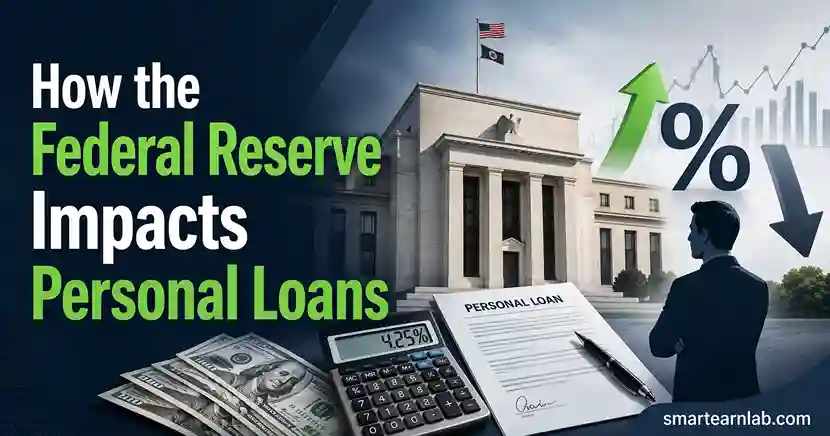
The Federal Reserve has a role in deciding how much it costs to borrow money in the United States. Understanding how the Federal Reserve impacts personal loans starts with the federal funds rate, which can affect how much it costs banks to borrow money. Over time, these changes can influence interest rates on personal loans and other types of borrowing.
As of September 2026, the Federal Open Market Committee (FOMC) increased its target federal funds rate by 0.25 percentage points to a range of 3.75% to 4.00%. The change went into effect on September 17, 2026. The Fed said inflation is still high and that the decision is meant to help bring inflation toward its 2% goal. These rate changes can help explain how the Federal Reserve impacts personal loans and borrowing costs.
How Does the Federal Reserve Affect Personal Loan Rate?
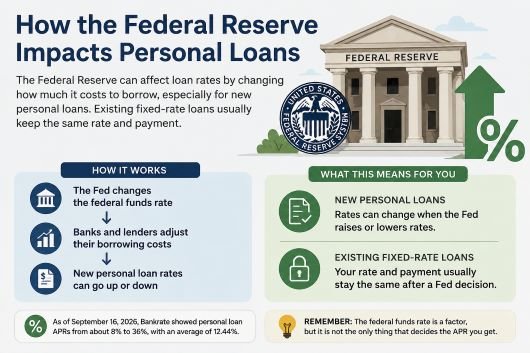
The federal funds rate is the rate that banks use when they lend money to each other overnight. Although people do not usually borrow loans directly at this rate changes in the federal funds rate can affect the overall cost of borrowing.
When the Fed increases rates, banks can face higher costs to get money. These higher costs might eventually show up as higher interest rates for new borrowers. When monetary policy becomes less strict, borrowing costs can go down. Understanding how the Federal Reserve impacts personal loans is important because personal loan rates do not always change right away or by the same amount.
Personal loan prices also depend on things like credit score, income, debt-to-income ratio, loan amount how long the loan’s the lenders view of risk.
What Happens to Existing Personal Loans?
Most personal loans have fixed interest rates. This means the rate you get when you take out the loan usually stays the same while you pay it back.
So a Federal Reserve rate increase usually does not make the interest rate or monthly payment on an existing fixed-rate loan go up.
This can help borrowers have payments even when other interest rates are changing.
Will Personal Loan Rates Fall in 2026?
Whether personal loan rates go up or down depends on more than one decision from the Federal Reserve. Understanding how the Federal Reserve impacts personal loans also involves factors such as inflation, economic conditions, competition between lenders, credit conditions, and how many people want to borrow.
The Fed’s September 2026 decision moved the target rate to 3.75% to 4.00%. The Federal Reserve’s past data also shows changes in the target rate, helping explain how the Federal Reserve impacts personal loans and borrowing costs.
Personal loan rate may not change after a fed announcement. Lenders can adjust prices slowly as the market changes.
How Can We Get a Lower-Cost Personal Loan?
Even if interest rates are high there are ways to make borrowing less expensive:
- Look at offers from lenders.
- Check your credit reports and credit scores before applying to understand how the Federal Reserve impacts personal loans and the rates you may receive.
- Use prequalification if its available to see what offers you might get.
- Borrow what you really need.
- Pick the repayment period you can handle, especially as the Federal Reserve impacts personal loans and borrowing costs.
- Think about if a co-borrower with credit could help your application.
- Look at the APR of just the interest rate advertised.
- Check origination. Other costs of borrowing.
As of September 16, 2026, Bankrate showed personal loan APRs from about 8% to 36%, with an average of 12.44% in its data. These differences in borrowing costs can help explain how the Federal Reserve impacts personal loans and the rates borrowers may receive.
Federal Reserve Rates vs. Personal Loan Rate
The connection can be described like this.
[Federal Reserve Monetary Policy]–>[Federal Funds Rate]
–> [Lender Funding and Market Conditions]
–> [Personal Loan Pricing]
–> [Borrower APR and Total Loan Cost]
The federal funds rate is a factor, but it is not the only thing that decides the APR you get. Understanding how the Federal Reserve impacts personal loans can help explain why loan rates vary between borrowers and lenders.
Bottom Line
The Federal Reserve can affect loan rates by changing how much it costs to borrow. Understanding how the Federal Reserve impacts personal loans is important, but this effect is usually more noticeable with new personal loans than with existing fixed-rate loans. Since most personal loans have fixed rates, people with existing loans usually keep the same interest rate and payment after a Fed decision.
FAQs
How Does the federal reserve affect loan rates?
The Federal Reserve can change the rates that affect loans by the adjusting the federal funds rate. This change can. Lower the cost that people pay to borrow money.
Do cuts, in Federal Reserve rates lower loan rates?
They can. When the Federal Reserve cuts rates lenders may lower loan interest rates. The change depends on each lender and each borrower.
Do Fed rate hikes make personal loans more expensive?
They can. When the Federal Reserve raises rates lenders may increase loan interest rates. That makes new personal loans more expensive.
Does the Federal Reserve set loan rates?
No. The Federal Reserve does not directly set loan rates. Each lender decides the rate they offer for loans.
What affects your loan interest rate?
Your credit score, income, debt the amount of the loan the loan term and market interest rates can all affect your loan rate.
