
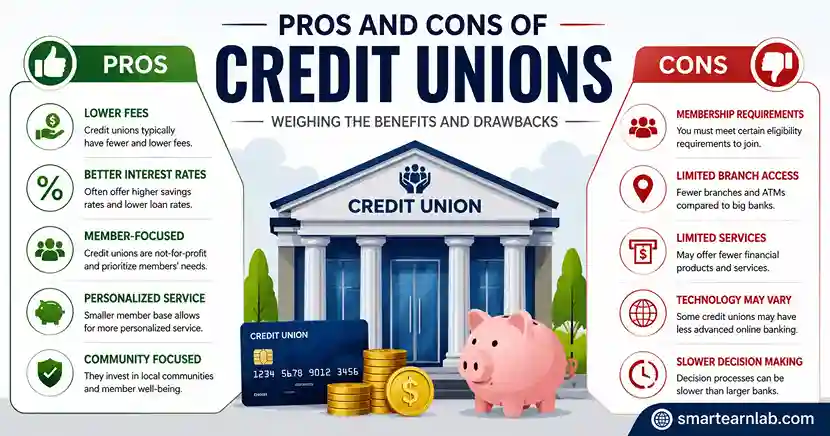
Credit unions can be a choice instead of ordinary banks for people who want better savings rates, cheaper loans and personal help. Credit unions are owned by their members. Are not-for-profit. Because of this they can give back earnings to members with rates and smaller fees. Understanding the Pros and Cons of Credit Unions can help people decide if a credit union is right for their financial needs.
Credit unions also have downsides. They have membership rules, fewer branches and their online services can be different which may make them less convenient than internet banks. Knowing the pros and cons of credit unions can help us decide if one fits our money needs.
What Is a Credit Union?
A credit union is a money place owned by its members, and understanding the pros and cons of credit unions can help you decide if one is right for you. It can give many of the services as a bank, such as checking, savings, certificates of deposit, mortgages, car loans, personal loans, credit cards and money market accounts.
Because members own a credit union it usually aims to give back value to its members of making big profits for outsiders.
Benefits of Credit Unions
Competitive Rates
One of the perks of credit unions is that they can offer good interest rates, which is one of the key advantages discussed in the pros and cons of credit unions. You may get rates on savings and certificates and lower rates on mortgages, car loans and personal loans. Understanding the Pros and Cons of Credit Unions can help you compare these competitive rates with other financial institutions.
A lower borrowing rate can cut the interest you pay over a loan’s life and a higher savings rate can make your money grow quicker.
Lower Fees
Many credit unions charge fees on their services. Depending on the place you might see monthly maintenance, overdraft or other fees than some regular banks.
Personalized Service
Credit unions usually focus on helping members. Their local branches and small teams can give a personal banking feel, which can be helpful when you need advice on loans or other money choices.
Deposit Protection
Credit unions that are insured by the government give safety for deposits through the NCUA up to $250,000 per person per ownership type. This is similar to the safety at FDIC banks.
Disadvantages of Credit Unions
Membership Requirements
You cannot automatically join any credit union. Eligibility can depend on where you live, work, a group you belong to, ties or family links. Some credit unions have rules but you still need to check the requirements.
Fewer Branches and ATMs
Credit unions often have branches than big national banks. This can be a hassle if you travel a lot and need a branch far from home. Shared branches and ATM networks can ease this problem.
Online Banks May Offer Higher Rates
Credit unions can give savings rates but some online banks might give even better rates because they spend less on operations. You should compare both before you open an account.
Digital Features Can Vary
Technology matters too. Some credit unions have mobile apps and online banking but others offer fewer tools than big banks. Check deposits, bill pay, payment services and account management before you join.
Credit Unions vs. Banks
| Feature | Credit Unions Banks |
| Ownership | Member owned | Shareholder owned |
| Membership | Eligibility required | Usually open to customers |
| Savings rates | Often competitive | Varies |
| Loan rates | Often competitive | Varies |
| Branch network | Usually smaller | Often larger |
| Digital banking | Varies | Often extensive |
Bottom Line
The pros and cons of credit unions rely on what matters to you. Credit unions can give rates, low fees, personal help and federal deposit safety. Membership rules, fewer branches and different technology may make normal or online banks more appealing, for some.
Before picking a credit union you should compare rates, fees, insurance, how easy it’s to reach membership rules and digital tools to find the bank that fits your needs best.
FAQs
What are the main pros of credit unions?
Credit unions can have fees. They often offer interest rates. Members get service. Credit unions focus more on their member than on making profits.
What are the disadvantages of credit unions?
Some people find it hard to join because of membership requirements. There are branches compared to big banks. Services may be limited. Some credit unions do not have technology like online banking tools.
Are credit unions better than banks?
It really depends on what we need. Credit unions might give interest rates and lower fees. Banks may have branches, a wider range of products and stronger digital banking options.
Why do credit unions have membership requirements?
Credit unions are owned by their members. That means you must meet eligibility rules to join. These rules help keep the institution focused on serving groups of people.
Are credit unions safe?
Yes insured credit unions are protected by the National Credit Union Administration (NCUA). This insurance covers deposits up to the limits set by law. So your money is safe, in cases.
