
Filing an IRS tax extension gives taxpayers time to the submit their federal income tax return. For the 2025 tax year and the regular federal filing deadline is April 15 2026. If taxpayers get an approved extension they usually have until October 15 2026 to file their income tax return.
A tax extension gives taxpayers time to file but it does not give them extra time to pay their federal income tax. Taxpayers should pay their income tax by the original April deadline to avoid interest and late payment penalties.
What Is an IRS Tax Extension?
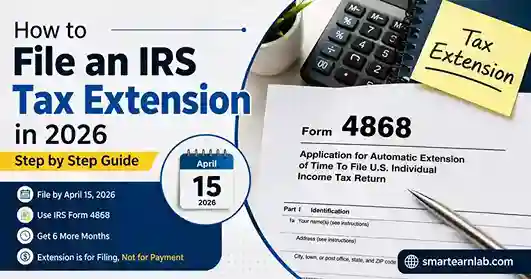
An IRS tax extension is a request for time to file a federal income tax return with the IRS. Most individual taxpayer can request an extension by the submitting IRS Form 4868. This form is called the application for automatic extension of time to file U.S. Individual income tax return.
Taxpayers can use an extension when they are still collecting tax documents or calculating deductions and credits. An extension can also be useful when dealing with income or when taxpayers simply need more time to prepare an accurate return.
However an IRS tax extension does not extend the payment deadline for income tax.
2026 IRS Tax Extension Deadline
For the 2025 tax return the standard deadline is April 15 2026. If taxpayer request an extension by the deadline the extended filing deadline is the generally October 15 2026.
Some taxpayers may qualify for additional time because of certain circumstances. These circumstances can include declared disasters, military service or living abroad. Taxpayers should always check the IRS deadline.
How to File an IRS Tax Extension
1. Estimate Your Federal Income Tax Liability
Before requesting an IRS tax extension taxpayers should estimate their federal income tax liability. They should compare it with taxes already paid through withholding or estimated payments. This helps determine whether taxpayers are likely to receive a refund or owe federal income tax.
If taxpayers expect to owe money estimating the amount accurately is important. This is because an IRS tax extension does not postpone the payment deadline for income tax.
2. Submit IRS form 4868
Taxpayer can request an IRS tax extension electronically or by mailing Form 4868 to the IRS. Electronic filing is generally the option and can provide confirmation that the request was submitted.
When completing the form taxpayers should carefully check their identifying information, estimated income tax liability, payments already made and expected balance due for federal income tax.
3. Pay as Much Federal Income Tax as Possible
If taxpayers owe income tax paying as much as possible by April 15 can reduce potential interest and late-payment penalties. Taxpayers do not necessarily need to pay the balance to request an IRS tax extension.
Taxpayers who cannot pay their balance may also consider an IRS payment plan or other available payment options for federal income tax.
4. Check State Tax Extension Requirements
An IRS tax extension does not automatically mean that every state income tax deadline is extended. Some states recognize the extension automatically while others require a separate state extension request.
Taxpayers should therefore check the tax agency for the state where they live, work or owe income tax.
- IRS Tax Extension
- Tax Payment
The important rule is simple: an IRS tax extension gives taxpayers more time to file their return not more time to pay their federal income tax.
For example if taxpayers owe $4,000 and receive a filing extension they should still try to pay the estimated $4,000 by the April deadline. Filing the return later does not eliminate interest or payment-related penalties for federal income tax.
IRS Tax Extension Timeline
Is there a penalty for filing an IRS tax extension?
There is generally no penalty, for requesting a filing extension when the request is submitted correctly and on time. The major concern is failing to pay income taxes that are due.
A late payment penalty may apply when taxpayers owe income tax and do not pay by the original deadline. Interest can also accrue on federal income tax.
Can Taxpayers File an IRS Tax Extension Online?
Yes. Federal tax extension can generally be requested electronically through IRS supported filing options or tax software or a tax professional. Online filing can make it easier to the receive confirmation and avoid mailing delays.
What happens after filing an IRS tax extension?
After obtaining an IRS tax extension taxpayer should use the time to gather missing document or review income claim eligible deductions and credits and complete the tax return accurately.
FAQs
What is a tax extension?
It gives you more time to file your tax return not to pay taxes.
Can i file a tax extension online?
Yes, you can file an extension electronically.
Is there a penalty for the filing an extension?
No penalty applies simply for properly requesting an extension on time.
Can i get an extension if I expect a refund?
Yes, although you may not need one if you can file your return on time.
Does a federal extension extend state taxes?
Not always. State extension rules vary.
