
Filing a tax return can become difficult when important documents are missing or financial information is complicated or more time is needed to the prepare an accurate return. A federal tax extension can provide additional time to the file your U.S. federal income tax return but it does not automatically give you extra time to the pay taxes you owe.
For the 2026 tax season most individual taxpayer can request an extension using IRS form 4868. A timely extension generally move and the federal filing deadline from April 15, 2026 to October 15, 2026.
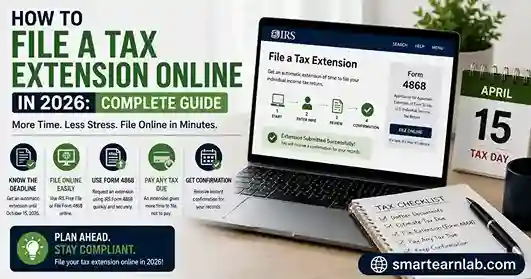
What Is a Tax Extension?
A tax extension is an official request for the additional time to submit your federal income tax return. Individual taxpayers generally use form 4868 application for automatic extension of time to the file U.S. Individual income tax return.
The extension applies to filing your return not paying your tax liability. If we expect to owe money we should estimate the amount and pay as much as possible by the original tax deadline. Waiting to pay can result in interest and penalties.
How to file a tax extension online
Filing an extension online is often the fastest and the simplest option. We can generally request an extension through approved tax software or by making an eligible electronic tax payment.
1. Use IRS Free File
Eligible taxpayers can use IRS Free File for tax preparation, while taxpayers can also use the program to submit an extension request regardless of income in certain circumstances.
2. Use Tax Software
Many tax-preparation platforms provide an extension option. After signing in we typically select the tax-extension feature provide the requested information, estimate our tax liability and electronically submit Form 4868.
3. Make an IRS Electronic Payment
An electronic payment can also indicate that we are requesting an extension. This can be useful because the payment helps establish the extension request while allowing us to pay toward any expected tax balance.
What information do we need for form 4868?
Form 4868 generally requires basic taxpayer information including:
- Full name and address
- Social Security number or ITIN
- Estimated total tax liability
- Total payments already made
- Estimated balance due
- Amount being paid with the extension request
We should use the most accurate estimate possible. Reviewing the previous year’s return, current income records withholding information and estimated tax payments can help produce a reasonable calculation.
Does a Tax Extension Give More Time to Pay?
No. A federal tax extension generally gives us more time to file the return, not more time to pay the tax owed.
If we expect a balance due, making a payment by the original deadline can reduce potential interest and penalties. Even if we cannot pay the entire amount paying as much as possible may reduce the amount subject to additional charges.
What happens if we expect a tax refund?
Taxpayers generally do not face a late payment penalty when they are entitled to a refund but filing an extension can still be useful. An extension provides additional time to prepare an accurate return and can protect against a potential late filing penalty if the final calculation unexpectedly shows a balance due.
Can we file a tax extension by mail?
Yes. We can complete Form 4868 and mail it to the appropriate IRS address. When filing close to the deadline, retaining proof of mailing can be important.
Electronic filing is generally more convenient because we receive an electronic acknowledgment and can avoid delays associated with paper processing.
Who Should Consider Filing a Tax Extension?
A tax extension may be appropriate when we:
- Need additional time to collect tax documents.
- Are waiting for forms such as a 1099 or Schedule K-1.
- Need more time to review complicated financial information.
- Cannot complete the return before the filing deadline.
- Experienced a major life event that delayed tax preparation.
- Need additional time to organize records for self-employment income.
- Want additional time to make certain eligible retirement-plan decisions.
When Should We Avoid Relying on an Extension?
An extension should not be used simply to delay paying an existing tax bill. If we know that we owe taxes, we should estimate the liability and make a payment by the original deadline whenever possible.
If paying the full amount is difficult we can still file on time or request an extension while paying what we can. We may also investigate available IRS payment arrangements.
Automatic Tax Extensions
Certain taxpayers may qualify for the additional filing time without submitting a standard extension request. Special rules can apply to eligible U.S. citizens or residents living abroad or certain military personnel and taxpayers affected by federally recognized disasters.
Because eligibility and the deadlines can vary we should verify the rules that apply to our specific circumstances before relying on an automatic extension.
Tax extension deadline for 2026
For most individual federal taxpayers and the standard 2026 filing deadline is April 15, 2026. A timely federal extension generally provides until October 15, 2026 to file the individual federal return.
State tax deadlines can differ. A federal extension does not necessarily mean that a separate state extension is automatically granted so we should check the requirements of the state where we file.
Final Checklist for Filing a Tax Extension
Before submitting an extension we should confirm:
- Our personal information is correct.
- Our estimated tax liability is reasonable.
- Previous tax payments and withholding are included.
- Any expected balance due is paid when possible.
- Form 4868 is submitted by the applicable deadline.
- Electronic confirmation or proof of mailing is retained.
- State extension requirements have been reviewed.
- The final tax return is completed before the extended deadline.
A tax extension can provide valuable breathing room when we need additional time to prepare an accurate return. The key is to remember that the extension changes the filing deadline not the basic deadline for paying taxes owed.
FAQs
What is a tax extension?
It gives you extra time to the file your tax return.
How can i file a tax extension online?
You can file electronically through approved tax filing services.
Can I file an extension after the tax deadline?
Usually you should request the extension before the original filing deadline.
Does a tax extension give more time to pay taxes?
No. You generally still need to pay taxes owed by and the original deadline.
Is filing a tax extension free?
Some options are free while others may charge a fee.
