
Understanding how credit card interest works lets us manage costs and make credit choices. Credit cards give convenience or rewards and flexible payments. If we keep a balance the interest that builds up can become costly.
The good news is that we can usually skip purchase interest if we pay the statement balance in full by the date. If we keep a balance the card issuer will usually use the cards APR and compute interest as the account terms say.
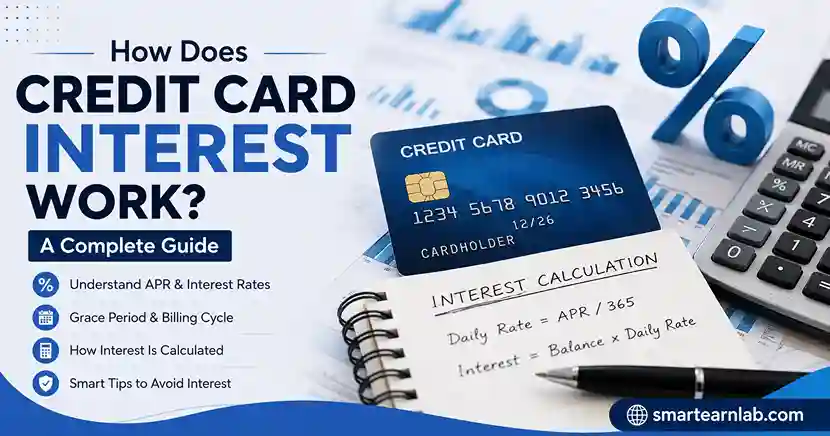
How Does Credit Card Interest Work?
Every time we buy something with a credit card the cost shows up on our balance. If we pay the statement balance by the payment due date we normally avoid interest on those purchases when the card has a grace period.
Paying the minimum lets the rest of the balance keep growing credit card interest. The longer we carry debt the interest we pay which makes it harder to cut the main balance.
Credit card interest is usually based on the cards annual percentage rate (APR) and a periodic rate. Since interest can be tallied each day keeping a balance longer can raise the borrowing cost.
What Is Credit Card APR?
A credit card APR shows the cost of borrowing on a credit card. It is one of the vital figures we should check before applying for or using a credit card.
Our credit card interest work can depend on our credit profile the issuer’s terms and the transaction type. Some cards have different APRs for purchases or balance transfers and cash advances.
We can usually locate the APR in the cardholder agreement the credit card statement or the online account.
How Is Credit Card Interest Calculated?
Credit card issuers usually use a periodic rate to compute interest. A simple way to guess that daily rate is:
periodic rate = APR ÷ 365
For example a 24% APR would give an approximate daily periodic rate of 0.0658%.
The issuer then applies the rate to the balance following the calculation method in the card agreement. Real interest calculations can differ so we should always review our cards terms.
Example of Credit Card Interest
Suppose we keep a $1,000 balance on a card with a 24% APR. The approximate daily rate would be.
24% multiply 365 equal 0.0658% per day
At a $1,000 balance and the estimated interest for one day would be about $0.66. Real charges can vary because balances or payments, purchases and the issuers calculation method can shift during and the billing cycle.
Common Types of Credit Card APR
Different transactions can have rates:
Purchase APR: This rate applies to purchases when interest is added.
Balance transfer APR: This rate applies to balances moved from another credit account.
Cash advance APR: This rate is often higher than the purchase APR. May start adding interest right away.
Penalty APR: This rate may apply after late payments depending on the card’s terms.
Knowing which APR applies to each transaction helps us gauge the cost of using our credit card.
What Is a Credit Card Grace Period?
A credit card grace period is the time between the end of a billing cycle and the payment due date. For purchases paying the statement balance in full by the due date can help us avoid interest.
For example if our statement balance is $1,000 and we pay the $1,000 by the due date we normally will not pay purchase interest for that billing cycle when the account has a grace period and we meet its rules.
Paying the minimum does not clear the remaining balance. That unpaid amount can keep adding interest.
What Happens If We Pay the Minimum?
The minimum payment keeps the account current. It usually does not stop interest from building on the remaining balance.
For this reason we should treat the payment as a requirement to keep
FAQs
How does credit card interest work?
Credit card interest is charged on unpaid balances based on the card APR and terms.
How can we avoid credit card interest?
We can usually avoid purchase interest by paying the full statement balance by the due date.
What is credit card APR?
Credit card APR is the annualized rate used to calculate the cost of borrowing.
Is credit card interest calculated daily?
Many issuers calculate interest using a daily periodic rate.
Does paying the minimum avoid interest?
No paying only the minimum can leave a balance that continues to accrue interest.
