When you work for yourself saving for retirement can be really tough. You do not have a retirement plan from your employer so you have to choose an account and understand the rules for contributing to it. You also have to build a plan around the money you make from your business which can change from year to year. Luckily there are self employed retirement plans that can help you save money on taxes and build a safe financial future.
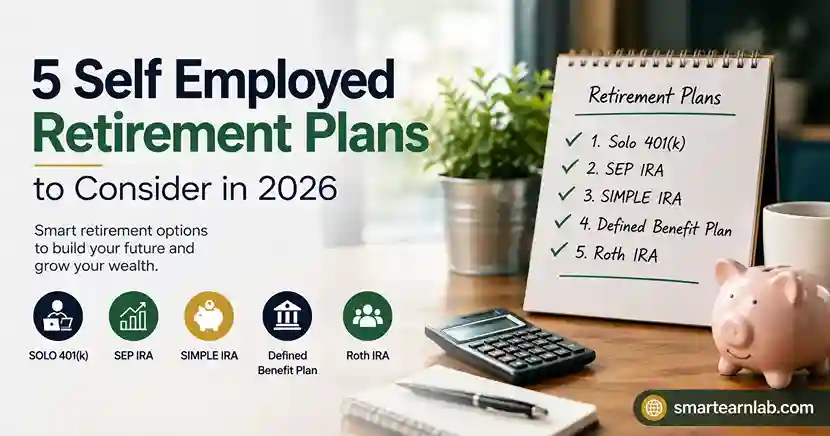
The five options you should think about are Roth IRAs, Solo 401(k)s, SEP IRAs, SIMPLE IRAs and defined benefit plans. The right choice for you depends on how money you make if you have employees how much you want to contribute and when you plan to retire.
1. Traditional or Roth IRA
A Roth IRA is often the easiest way to the start saving for the retirement when you are self employed. You can open an IRA even if you do not have employ or a retirement plan for your business.
In the year 2026 people can put, up to $7,500 into an Individual Retirement Account every year. If you are fifty years old or more you can put a $1,100 into your Individual Retirement Account.
With a Traditional IRA the money you contribute may reduce the amount of the taxes you pay now but you will have to pay taxes when you take the money out in retirement. A Roth IRA does not give you a tax break now. The money you take out in retirement can be tax-free.
For people who are just starting out as freelancers, contractors or business owners an IRA is a good way to start saving for self employed retirement plan because it is easy to set up.
2. Solo 401 (k)
A Solo 401 (k) can be a good option for business owners who do not have employees except maybe their spouse. You can contribute to the plan as both the employee and the employer which means you can save a lot money than you could with an IRA.
In 2026 you can contribute up to $72,000 to a Solo 401(k) each year depending on how money you make and the rules of the plan. If you are 50 years old or older you may be able to contribute more.
A Solo 401(k) can be especially useful when your business is making a lot of money because you can contribute both as an employee and as an employer. You may also be able to choose a Roth option, which can give you tax- money in retirement.
3. SEP IRA
A SEP IRA is designed for self employed people and small businesses. One of the things about a SEP IRA is that you can contribute a lot of money to it and it is relatively easy to set up and manage.
In 2026 you can contribute up to $72,000. 25% Of your eligible compensation to a SEP IRA depending on the rules.
One thing to think about is employees. If you contribute to a SEP IRA for yourself you generally have to contribute the percentage of compensation for your eligible employees. This can make a SEP IRA less appealing as your business grows.
4. SIMPLE IRA
A IRA can be a good option for the small businesses that want to offer their employees a retirement benefit without a lot of the complexity.
In 2026 employees can contribute up to $17,000 to an IRA each year and if they are 50 years old or older they may be able to contribute more.
Unlike a SEP IRA employees can contribute to an IRA through salary deferrals. Employers generally have to make matching or nonelective contributions to the plan well. This makes a SIMPLE IRA a good option for businesses that want their employees to be able to save for retirement.
5. Defined Benefit Plan
A defined benefit plan is like a pension plan and it can be a good option for self employed people who make a lot of money and want to save a lot for retirement.
With a defined benefit plan the amount of money you can get in retirement is based on things like your age, income and retirement goals. The contributions you make to the plan are generally tax deductible. You will have to pay taxes on the money you take out in retirement.
These plans can be complex and expensive to set up and manage. They require ongoing funding commitments. They are generally best for business owners who make a lot of money and are close to retirement.
How We Can Choose the Right Plan
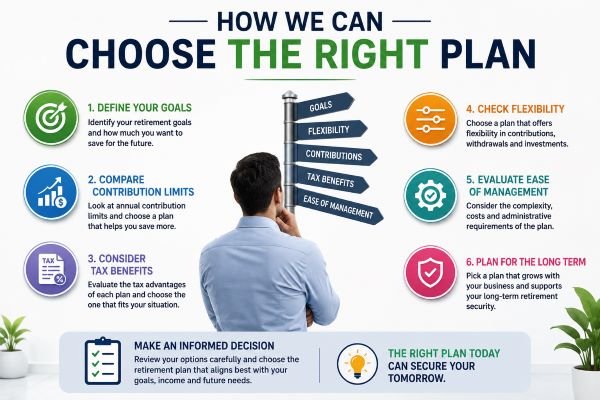
You should start by thinking about how much you want to the save whether you have employees how predictable your income is and whether you prefer tax benefits now or tax free money in retirement.
If you do not have employees a solo 401(k) might be more flexible than a SEP IRA. If you are just starting out as a freelancer or business owner an IRA might be an option because it is easy to set up. If you have employees you will need to think about the rules for SIMPLE IRAs and SEP IRAs.
Retirement Planning Flow
Start Self Employed Retirement Planning –> Have Employees?
–> No {Want Higher Contributions?}
–> Yes {Employees to Contribute?}
–> Yes [Solo 401(k)]
–> No [Traditional or Roth IRA]
–> Yes [SIMPLE IRA]
–> No [SEP IRA]
–> {High Income and Near Retirement?}
–> Yes [Consider Defined Benefit Plan]
Bottom Line
The self employed retirement plan is the one that fits your business and your goals. A Traditional or Roth IRA is simple and easy to set up. A Solo 401(k) or SEP IRA can let you save a lot of money. A SIMPLE IRA can help your employees save for retirement. A defined benefit plan can be an option if you make a lot of money and are close to retirement.
By comparing the plans and thinking about your business and your goals you can choose a retirement plan that will help you build a safe financial future.
FAQs
What are the best retirement plans for self employed people in 2026?
Popular options include Solo 401(k) SEP IRA, SIMPLE IRA, defined benefit plans and the Roth IRA.
Is a solo 401(k) good for self employed individuals?
Yes. A solo 401(k) may be a choice for a business owner with no employees because a Solo 401(k) may allow both employee and employer contributions.
What is a SEP IRA?
A SEP IRA is a retirement plan designed for self employed individuals and small business owners. A SEP IRA allows eligible employers to the make contributions for themselves and the eligible employees.
Can self employed people have a Roth IRA?
Yes. Self employed individuals can contribute to a Roth IRA if self employed individuals meet the income and eligibility requirements.
Which retirement plan is best, for a self employed person?
The best plan depends on income, business structure or employees contribution goals and tax situation.
