
Invest in funds offer a simple way to invest in a diversified collection of stocks, bonds or other assets through a single investment. Of selecting and the managing every security individually we can buy shares of a fund that pools money from many investors and is managed according to a specific investment strategy.
In 2026 mutual funds remain useful for investors who want diversification or the professional management and a structured approach to the long term investing. The key is choosing funds that match our goals or risk tolerance, time horizon and the investment budget.

What is a mutual fund?
A mutual fund pools money from investors and uses that money to purchase a portfolio of the investments. Depending on the fund those holdings may include stocks or bonds, money market securities or other assets.
When we invest in a fund we own shares of the fund rather than directly owning every stock or bond inside its portfolio. The value of our investment changes as the underlying holdings. Lose value.
Mutual funds can be purchased through brokerage accounts or retirement accounts and in some cases from the fund company.
How do mutual funds work?
Mutual funds generally fall into two management styles: actively managed. Passively managed.
Active funds have managers who select investments with the objective of outperforming a benchmark or market. Because they involve research and management their fees can be higher.
Passive funds generally follow a predefined index or investment strategy. Their limited management requirements can result in costs.
Mutual fund investment process
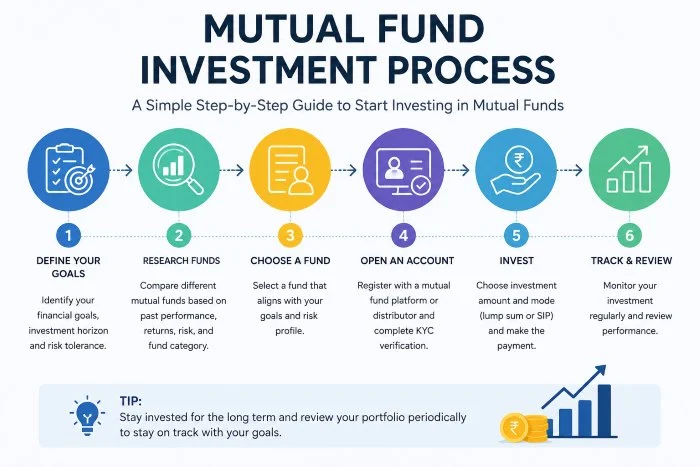
[Set Investment Goals] –> [Choose Fund Type]
–> [Compare Fees and Risk]
–> [Choose Brokerage Account]
–> [Buy Mutual Fund Shares]
–> [Monitor and Rebalance]
Benefits of the investing in mutual funds
Diversification
One of the advantages of mutual funds is diversification. A single fund can provide exposure to securities helping us avoid relying entirely on the performance of one company or asset.
Professional management
With a managed fund professional managers research securities and make portfolio decisions. This can reduce the amount of day to day investment selection required from investors.
Simplicity
Mutual funds can make portfolio construction easier because one investment may contain dozens or hundreds of underlying holdings. We can use a number of the appropriately selected funds to build a diversified portfolio.
Lower costs
Costs vary significantly between funds. Passive mutual funds can have low expenses while actively managed funds may charge more for professional management. Comparing expense ratios is therefore essential before investing.
How to invest in funds in 2026
1. Define your investment goal
Before choosing a fund we should determine why we are investing. Retirement, long term wealth building, education expenses and other goals may require strategies.
We should also consider our investment time horizon and ability to tolerate market losses.
2. Choose between passive funds
Active funds attempt to outperform a benchmark while passive funds generally aim to track one. Passive investing can offer a hands off approach and often comes with lower expenses.
For long term investors, comparing costs and consistency may be more useful than simply selecting the fund with the strongest recent performance.
3. Determine how much to invest
funds can have minimum investment requirements. The source article notes that many fund minimums historically fall around $500 to $3,000 while some funds have even $0 minimums.
We should invest an amount that fits comfortably within our financial plan rather than stretching our budget to meet a minimum.
4. Choose where to buy funds
We can access mutual funds through employer sponsored retirement plans, brokerage accounts, financial advisors or sometimes directly through fund companies. Brokerage accounts can provide access to funds from fund families.
When comparing brokers we should consider funds, transaction costs, research tools, account fees and ease of use.
5. Compare mutual fund fees
The expense ratio is one of the important costs to examine. It represents the operating expenses charged by the fund as a percentage of invested assets.
For example a 1% expense ratio would cost $10 annually for every $1,000 invested before considering investment gains or losses.
We should also check whether a fund has sales loads or other transaction related costs.
Types of mutual funds
Stock Mutual Funds
Stock or equity mutual funds invest in stocks. They generally offer growth potential but also greater market risk and volatility.
Bond mutual funds
Bond funds invest in debt securities issued by the governments companies or other entities. They generally have growth potential than stock funds but can play an important role in a diversified portfolio.
Money market mutual funds
Money market funds invest in quality short term debt instruments and are generally designed for the stability and liquidity rather than high long term growth.
Target date funds
Target date funds can automatically adjust their asset allocation as an investor approaches a selected target year. This can simplify portfolio management for the long term goals such as retirement.
How to choose the best mutual fund
There is no best mutual fund for every investor. Instead we should evaluate a fund based on factors:
Investment objective: Does the fund fit our goal?
Risk level: Can we tolerate its losses?
Expense ratio: Are the costs reasonable?
Performance history: How has it performed over period?
Diversification: Does it provide exposure without the excessive concentration?
Minimum investment: Does it fit our budget?
Management approach: Is it active or the passive?
Portfolio holdings: What securities and the sector does the fund actually own?
Past performance should not be treated as a guarantee of the result. The source material specifically cautions against chasing performance and the recommend considering longer term consistency and the fund role within the overall portfolio.
Managing a mutual fund portfolio
Buying a fund is only the beginning. We should periodically review whether our portfolio still matches our investment goals and the risk tolerance.
One approach is to rebalance periodically when market movements cause our asset allocation to move away from the intended mix. For example if stocks grow to represent a larger percentage of a portfolio than originally planned we may need to adjust the allocation.
Mutual funds vs. ETFs
funds and exchange traded funds can both provide diversification through a basket of investments. The major differences include how they trade their structures or costs and the choices available through investment accounts.
Than choosing one solely because it is popular we should compare the specific funds costs or investment strategy, liquidity or tax considerations and suitability for our portfolio.
Common mistakes to avoid
Chasing recent returns
A fund that performed well recently may not repeat that performance. Selecting investments solely because they topped a performance table can expose us to unnecessary risk.
Ignoring fees
Small annual expenses can compound over years. Comparing expense ratios and other charges before the investing can help protect long term returns.
Overcomplicating the portfolio
Owning funds does not automatically mean better diversification. Different funds may hold many of the securities creating unnecessary overlap.
Investing without a plan
A mutual fund should have a purpose within our investment strategy. We should understand what role it plays before buying it.
The bottom line
Mutual funds can provide diversification or professional management and a simple way to build a long-term investment portfolio. The strongest approach is not necessarily to find the fund with the recent return. Instead we should focus on matching fund selection with our goals, risk tolerance, time horizon, diversification needs and costs.
By comparing passive strategies or researching fund holdings evaluating expense ratios choosing an appropriate investment account and reviewing our portfolio periodically we can make more informed mutual fund investment decisions in 2026.
FAQs
What are investment funds?
Investment funds pool money from the multiple investors to buy a diversified portfolio of assets such as stocks, bonds or other securities.
How do i start investing in funds?
Start by setting your financial goals, choosing a suitable fund type comparing fees and performance and opening an investment account with a reputable provider.
What types of funds can i invest in?
Common options include mutual funds, index funds or exchange traded funds (ETFs), bond funds and money market funds.
How much money do i need to invest in a fund?
The minimum investment depends on the fund and provider. Some funds allow investors to start with a relatively small amount while other have higher minimums.
Are investment funds safe?
Funds can reduce risk through diversification but they are not risk free. Their value can rise or fall depending on the market conditions and the assets they hold.
