
Staying on top of business tax deadline is one of the most effective ways to avoid IRS penalties and keep your business financially healthy. Whether you operate as a sole proprietor or the partnership, S corporation, C corporation or LLC, understanding the correct filing dates help ensure compliance throughout the year. Business structure determines filing requirements or estimated tax payment and the extension deadlines.
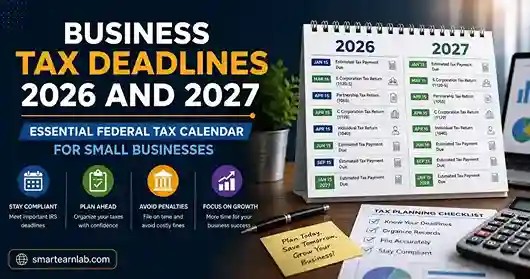
Quarterly estimated tax payment
Most businesses follow the IRS pay as you go tax system by making estimated tax payments throughout the year instead of the paying everything at tax filing time.
- Sole proprietor, partnerships and the corporations pay quarterly using Form 1040 ES.
- C corporations make estimated payments using IRS Publication 542 worksheets.
- Estimated taxes help avoid underpayment penalties and large year end tax bills.
Employer tax filing requirement
Businesses with employee have additional federal tax responsibilities.
- Form 941
- Employers must file Form 941 every quarter to report.
- Federal income tax withheld
- Social security tax
- Medicare tax
Timely payroll tax deposits may qualify employers for an extended filing deadline.
FUTA tax deposits
Federal Unemployment Tax (FUTA) deposits are generally required whenever cumulative FUTA liability exceeds the IRS threshold during the quarter. Payments are made electronically through EFTPS.
Annual business tax return deadlines
Business typically filing on March 15 include.
- Partnerships
- S Corporations
- Multi member LLCs taxed as partnership
Business generally filing by April 15 include
- Sole proprietorship
- Single member LLCs
- C Corporations
Tax Extensions
Businesses needing additional preparation time may request an extension before and the original filing deadline.
Important reminder
- Extension provide more time to file.
- They do not provide extra time to pay taxes owed.
- Interest and penalties may still apply if payment is late
- Avoid IRS Penalties
To remain compliant
- Schedule quarterly tax reviews.
- Track every central filing deadline.
- Maintain accurate book keeping throughout the year.
- Submit payroll tax deposits on time.
- File required information returns before their due dates.
- Work with an experienced tax professional when needed.
Missing deadlines can result in late filing penalties, late payment penalties and interest charges that continue accumulating until balances are paid.
Managing business tax deadlines requires consistent planning rather than last minute preparation. By following the federal tax calendar or making quarterly estimated payments and meeting employer tax obligations and filing annual return on time businesses can reduce penalties and maintain full IRS compliance. Establishing a reliable tax schedule throughout the year helps improve cash flow, simplifies tax preparation and keeps your business operating smoothly.
What are the main tax deadlines for businesses in 2026 and 2027?
These tax deadlines include paying estimated taxes dealing with payroll taxes and filing the federal tax return on time.
Why is it important for small businesses to keep track of tax deadlines?
If small businesses track tax deadlines they can avoid paying money because of late fees and penalties.
What kind of businesses need to follow the tax calendar?
Businesses like proprietors and partnerships and companies like LLCs and S corporations and C corporations need to follow the federal tax calendar.
What happens if a business misses a tax deadline?
If a business misses a tax deadline they may have to pay money as penalties and interest and it may take longer to the process their taxes.
How can businesses stay on top of tax deadlines?
Businesses can stay organized by using a tax calendar and setting reminders and keeping their records up to date, for tax deadlines.
