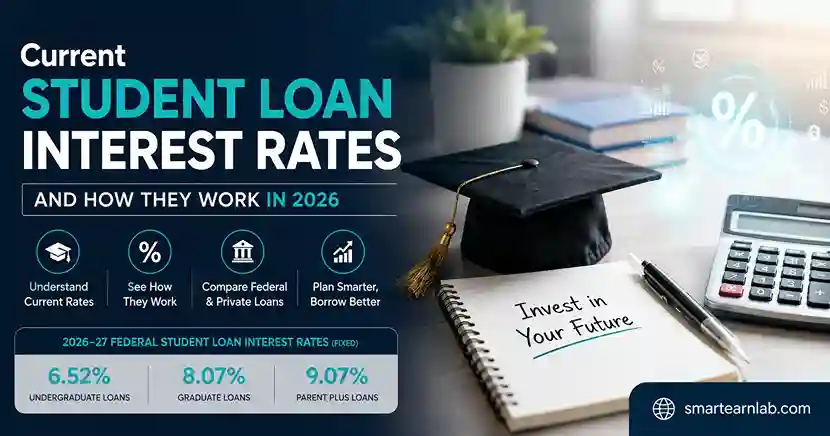
Understanding student loan interest rates 2026 helps us estimate the true cost of borrowing for college and choose the most affordable financing option. For the 2026–27 academic year new federal student loan rates are 6.52% for the undergraduate loans 8.07% for graduate loans and 9.07% for Parent PLUS loan. Federal rates are fixed for the life of each loan.
Private student loan rates vary by lender and borrower. We generally see lower rates offered to borrowers with strong credit while applicants with limited or weaker credit may receive higher rates or need a qualified cosigner.
How Student Loan Interest Works
Student loan interest is essentially the cost we pay for borrowing money. The amount of interest that accrues depends on the loan balance, interest rate and amount of time the balance remains outstanding.
A simplified calculation is:
Daily interest equal Principal balance × Annual interest rate ÷ 365
For example a $10,000 loan at 6.52% would initially accrue roughly $1.79 per day assuming the entire $10,000 remain outstanding.
Interest may accrue while we are attending school during a grace period or while a loan is in repayment depending on the loan type and applicable rules.
Federal vs. Private Student Loan Interest Rates
The biggest difference is how rates are determined.
Federal student loans generally offer fixed rate established under federal rules. Understanding student loan interest rates 2026 can help borrowers compare their financing options and estimate borrowing costs. Federal loans may also provide borrower protections and the repayment options that private loans do not necessarily offer.
Private student loans are offered by banks or credit unions and other private lenders. Rates are typically based on the factor such as credit history, income, debt and whether we apply with a creditworthy cosigner.
Before choosing a private loan, we should generally use available federal student aid first.
Fixed vs. Variable Student Loan Rates in 2026
Understanding student loan interest rates 2026 is important when comparing fixed and variable rate loans. A fixed interest rate stays the same throughout and the loan term making monthly payments easier to predict and helping borrowers plan their repayment costs with greater certainty.
A variable rate can change periodically according to the loan terms and a market based index. A variable rate may initially be lower but future payment can increase if the rate rises.
For borrowers who prioritize predictable payments or fixed rate financing may be easier to budget.
How to Lower Student Loan Interest Costs
We can potentially reduce the total cost of student debt by:
- Comparing multiple private lenders before borrowing.
- Applying with a qualified cosigner when appropriate.
- Enrolling in eligible automatic payments for available rate discounts.
- Making extra principal payments when financially practical.
- Paying accrued interest before it capitalizes when possible.
- Refinancing private or federal loans only after carefully evaluating the benefits and lost federal protections.
Refinancing federal loans into a private loan can reduce the interest rate for some borrowers but it can also eliminate federal benefits such as certain income-driven repayment and forgiveness protections.
How to Apply for Student Loans
We should generally follow this order:
1. Complete the FAFSA to determine eligibility for federal financial aid.
2. Use grants and scholarships before taking on additional debt.
3. Borrow federal student loans when needed.
4. Compare private student loans only for remaining education costs.
5. Compare APR, fees, repayment terms and rate type, rather than focusing only on the advertised interest rate.
Student Loan Interest Rates 2026: Interest and Repayment Strategy
Paying interest efficiently can reduce and the overall cost of borrowing. Understanding student loan interest rates 2026 can help borrowers manage interest costs more effectively. If unpaid interest is capitalized, it may be added to the principal balance meaning future interest can accrue on a larger amount. Paying accrued interest before capitalization can help limit the total cost of your student loan.
When we have extra money available we should first consider essential financial priorities such as an emergency fund and high interest debt. After those priorities are addressed, additional student loan payments can help reduce principal and future interest.
Student Loan Interest Rate Decision Guide
[Need money for college?]–>[Complete FAFSA]
–> [Use grants and scholarships]
–> [Consider federal student loans]
–> {Funding gap remains?}
–> |No|[Borrow only what is needed]
–> |Yes|[Compare private student loans]
–> [Compare APR, fees and repayment terms]
–> {Fixed or variable rate?}
–> |Fixed|[Predictable interest cost]
–> |Variable|[Potential rate changes]
–> [Choose affordable financing]
Key Takeaway
The 2026-27 federal student loan interest rates are 6.52% for undergraduate borrowers 8.07% for the graduate borrowers and 9.07% for Parent PLUS loans. Private student loan rate can differ substantially based on the lender and borrower.
The best approach is to compare the total borrowing cost, APR, fees, repayment options and borrower protection rather than choosing a loan based solely on its advertised interest rate.
FAQs
Can student loan interest rates be lowered?
Yes. Eligible borrowers may reduce rates through refinancing or available autopay discounts.
Is a fixed or variable student loan rate better?
Fixed rates offer predictable payments or while variable rates can change over time.
Should we choose federal or private student loans first?
We should generally use federal student loans before private loans because of their borrower protections and repayment options
Are federal student loan rates fixed?
Yes federal student loan rates are generally fixed for the life of the loan.
How do private student loan rates work?
Private rate vary based on credit or income, lender, and loan terms.
